JSON to XML
JSON data into XML format for seamless integration and compatibility. Simplify your development process and ensure data consistency with our user-friendly converter. Explore PDF SEO Tools for efficient JSON to XML conversion today
Result
Share on Social Media:
JSON to XML
In the world of web development and data interchange, two formats reign supreme: JSON (JavaScript Object Notation) and XML (eXtensible Markup Language). While JSON has become the preferred choice for modern APIs due to its simplicity and lightweight nature, XML remains a stalwart in many enterprise systems, configuration files, and specific industry standards.
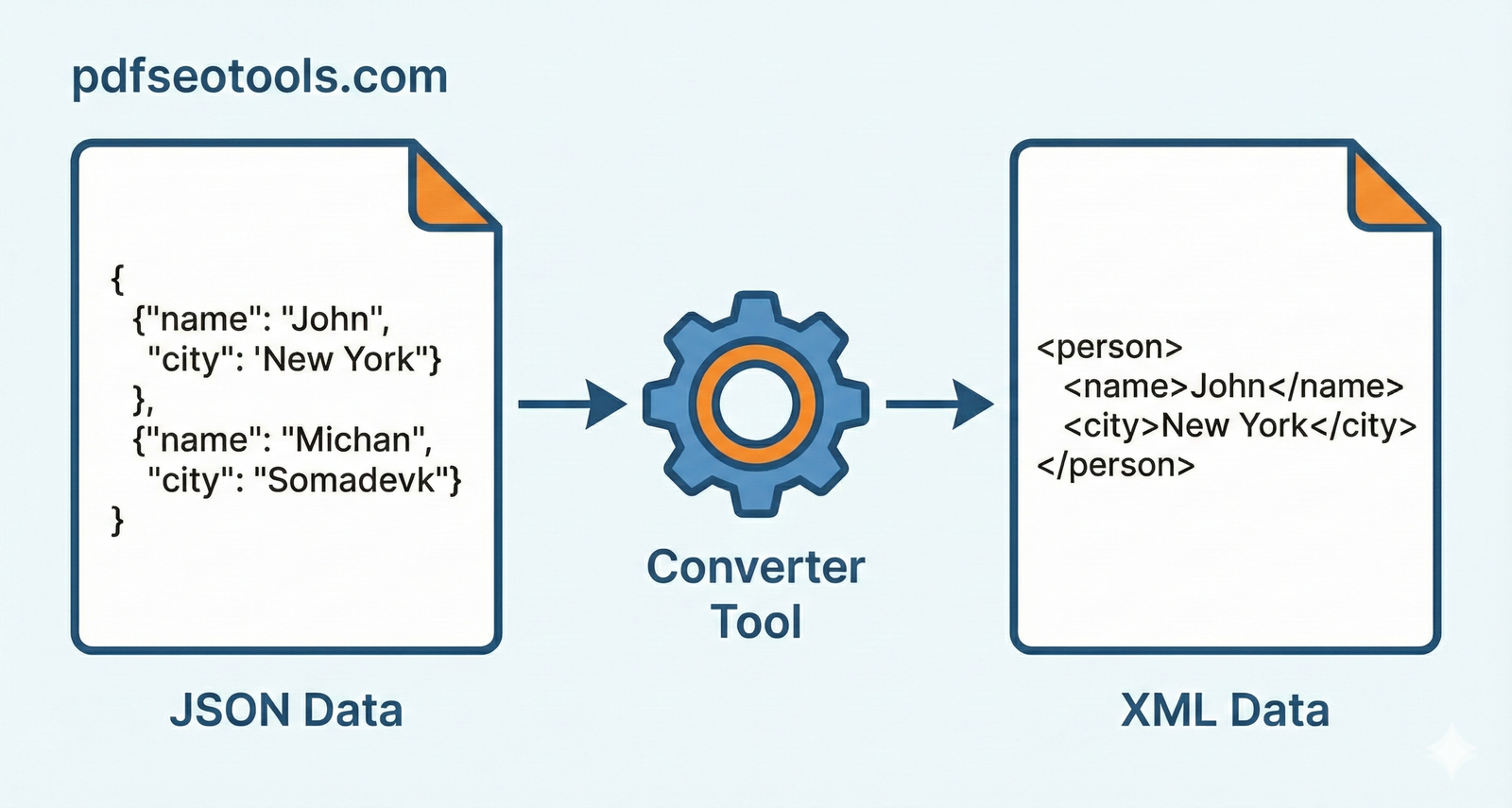
There are many situations where you might find yourself needing to convert data from one format to the other. This article will guide you through the process, explain the key differences, and introduce you to a simple, efficient tool for the job.
Understanding the Formats: JSON vs. XML
Before diving into conversion, it's helpful to understand what sets these two formats apart.
JSON is designed to be easy for humans to read and write, and easy for machines to parse and generate. It uses a map-like structure with key-value pairs and arrays. Its syntax is minimal, using curly braces {} to hold objects and square brackets [] for arrays.
XML is a markup language, meaning it uses tags to define elements and data structures, much like HTML. It is highly extensible and excellent for representing complex, hierarchical data. However, its reliance on opening and closing tags makes it more verbose than JSON.
The image below illustrates the conceptual flow of converting data from the JSON format to the XML format.
Why Convert JSON to XML?
You might need to convert JSON to XML for several reasons:
Integrating with Legacy Systems: Many older systems were built entirely around XML. To connect a modern JSON-based application with one of these systems, you'll need to convert the data.
Industry Standards: Some industries, such as finance or healthcare, have established data exchange standards that are exclusively based on XML.
Configuration Files: Certain software applications require configuration files to be in XML format.
SEO and Sitemaps: While modern SEO often uses JSON-LD for structured data, some older sitemap protocols or specific SEO tools may still rely on XML.
How to Convert JSON to XML Easily
Manually converting JSON to XML is tedious and prone to errors. A single missing bracket or tag can break the entire file. Fortunately, you don't have to do it by hand. You can use a reliable online tool to perform the conversion instantly and accurately.
For a fast and free solution, we recommend using this JSON to XML converter. It's a simple, browser-based tool that gets the job done in seconds.
Here is an example of what the interface of such a converter looks like.
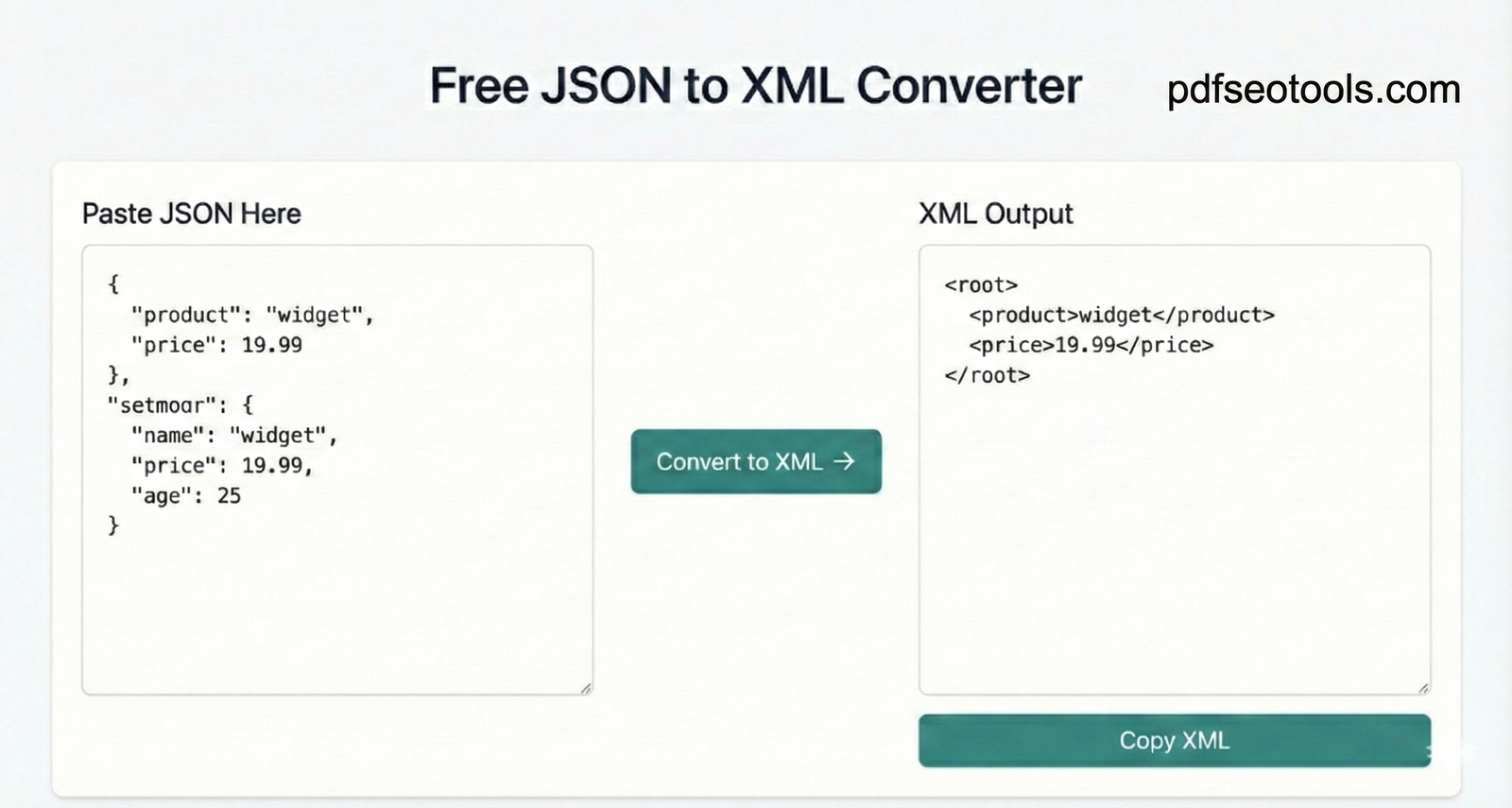
The process is straightforward:
Copy your JSON code.
Paste it into the input box on the converter tool.
Click the "Convert" button.
Your converted XML data will appear in the output box, ready to be copied or downloaded.
FAQs
Here are some common questions about JSON to XML conversion.
1. What is the main difference between JSON and XML?
JSON is a lightweight, data-interchange format that is easy for humans to read and write. XML is a markup language that is more verbose but offers more structural flexibility through tags and attributes.
2. Is the converted XML always perfectly structured?
A good converter will generate valid XML. However, since JSON lacks some of XML's features (like attributes), the converter may make assumptions. For example, JSON keys become XML tags.
3. Can I convert large JSON files?
Yes, most online converters can handle reasonably large files. For extremely large datasets, a command-line tool or a dedicated software solution might be more efficient.
4. Is the online converter tool free to use?
Yes, the JSON to XML tool linked in this article is completely free to use.
5. Is my data safe when using an online converter?
Reputable online converters process conversion on the client-side (in your browser) or do not store your data after conversion. However, for highly sensitive or confidential data, it's always a good practice to use an offline tool or review the tool's privacy policy.